


Welcome and thank you!
Having work carried out in your home isn't always easy. There may have been early starts, dusty floors, and days where your normal routine went out of the window, and we appreciate your patience more than we can say.
The good news? The hard part is all done. Your home is more efficient, and cheaper to run. This guide is here to help you make the most of that.

What's in this guide.
We've put together everything you need to get the most from your home, and keep your bills as low as possible.
Inside you'll find:
- Simple tips for heating your home efficiently.
- Easy ways to reduce your energy use day to day.
- How to read your meter and understand your bills.
- Financial support you may be entitled to.
- Gas and carbon monoxide safety.
- How to get in touch with us if you need help.
Your energy,
your money.
Energy bills are at the highest level most of us have ever seen. The improvements made to your home will help but the upgrades only go so far. Day-to-day habits, all the small things you all do without thinking, can quietly eat through energy and push costs back up. This guide is here to help you hold onto those savings, with simple advice on getting the most from your home.
Guilty as charged?
Count up your energy-wasting habits...
Give yourself a point for each one and find out your results on the next page.
I crank the thermostat up when I'm cold and hope for the best.
My TV, console and chargers haven't been fully off in years.
I boil a full kettle for one cup of tea. Every time.
The radiator doubles as a clothes horse in this house.
I wander between rooms, leaving every door open behind me.
There's a draught under my front door I've meant to sort for months.
I couldn't tell you the last time I had a shower instead of a bath.
I leave lights on in rooms nobody is in.
I wash my clothes hot... hotter means cleaner, right?
Set a heating timer? What heating timer?
Your score. We all start somewhere.
| 0-2 |
Energy savvy. You're already ahead of most households, and your bills show it. Have a read through the guide anyway; maybe there’s one or two extra pounds to be saved. |
| 3-5 |
On the right track. You're doing better than you think. A few small changes could make a real dent in your bills; pick one habit from your list and start there. |
| 6-8 |
Room to save. The good news is that there are savings to be made. Tackle one or two habits this week and build from there. This guide will show you how. |
| 9-10 |
Energy savvy. Everyone starts somewhere. The fact that you're reading this means you're already taking the right steps. Work through the guide at your own pace and you'll be surprised how quickly the small changes add up. |
Getting the most from your heating.
Whether your home has a gas boiler, electric heating or even a heat pump, how you use it has a big impact on your bills. A well-set system running efficiently can make a noticeable difference to how much energy you get through each month. These tips will help you get the most from whichever system you have.
Using your boiler effectively.
Managing electric heating.
Living with a heat pump.
Thermostat and radiator settings.
New boiler? Get every penny's worth.
A gas boiler is one of the biggest energy users in your home. Using it well doesn't require much effort, but it does make a real difference to your bills.
Find the flow-temperature sweet spot.
The flow dial controls how hot water gets as it moves through your radiators. Around 60°C is ideal - hotter just burns energy for little extra benefit.
Keep an eye on the pressure.
The gauge on the front should sit between 1 and 1.5 bar when the heating is off. If it keeps dropping, check your manual or the manufacturer's helpline.
Don't switch off completely overnight..
A cold house takes far more energy to reheat than one ticking over quietly. A low overnight setting around 15°C is the smarter move.
Get it serviced every year.
Once a year by a Gas Safe registered engineer. It keeps your boiler safe and efficient, and protects your warranty.
Got electric heating? It costs more to run, but you can keep a lid on it.
Electric heaters, storage heaters, and panel heaters all convert electricity directly into heat. They're simple and reliable, but electricity costs more per unit than gas, so how you use them matters more, not less.
Storage heaters.
These charge up overnight using cheaper off-peak electricity and release heat during the day. To get the most from them:
- Set the input dial the night before based on how cold the next day is likely to be. A mild day doesn't need a full charge.
- Use the output dial to control how quickly heat is released. Keep it lower in the morning and turn it up as you need it.
- If you're out during the day, turn the output right down. Heat released into an empty room is wasted.
Panel and convector heaters.
- Only heat the rooms you're using. These heaters respond quickly, so there's no need to leave them running in empty spaces.
- Use the built-in thermostat if your heater has one. Set it to a comfortable temperature and let it cycle on and off rather than running flat out.
- A timer plug costs around £10 and lets you set heating schedules on heaters that don't have built-in controls.
Did you know?
Switching to an Economy 7 or Economy 10 tariff if you have storage heaters can reduce your electricity costs significantly. It's worth checking with your supplier whether you're already on one.
Got a heat pump? It works differently... here's how.
Your Secure Controls thermostat gives you full control over when your home heats up and how warm it gets. Get these two things right and you'll barely need to touch it.
It heats slowly and steadily...and that's the point.
A boiler blasts heat quickly; a heat pump takes its time at a lower temperature for longer. Your home gets there, it just does it differently.
Turning it up won't speed things up.
This is the big one. Pushing the temperature higher doesn't make it work faster, it just makes it less efficient and pushes your bills up.
Set a comfortable temperature and let it run.
Heat pumps like consistency. Turning it off and expecting a quick reheat isn't how they work. Leave it ticking over and it'll look after you.
Radiators feel warm, not hot.
A heat pump runs at a lower flow temperature than a gas boiler. As long as your home is comfortable, everything is working exactly as it should.
In winter it'll work harder.
On very cold days it may seem to run all the time, and that's fine. That's exactly what it's supposed to do.
Heating controls. What should my thermostat be set to?
Your thermostat gives you full control over when your home heats up and how warm it gets. Get these two things right and you'll barely need to touch it.
Did you know?
Each degree you turn your thermostat above 21°C adds about 10% to your heating bill, so even a small change can save you money over winter.
Set it and forget it.
How to programme your timer in 3 steps:
Set your ON time.
30 minutes before you get up or get home.
Set your OFF time.
30 minutes before you go to bed.
Set your temperature.
Between 18°C and 21°C.
Done.
Your heating will now run with very little input from you.
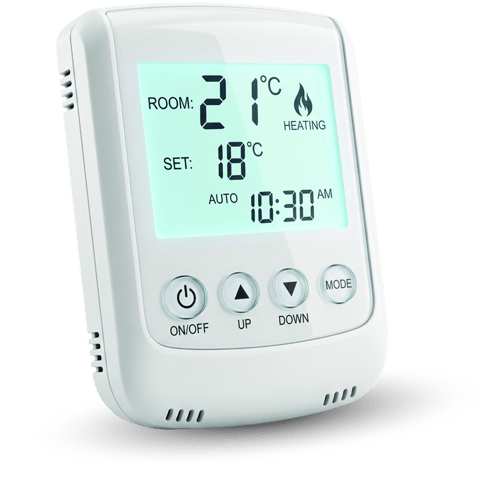
Heating controls. Here's where to turn the dials on your radiator.
If your radiators have a dial near the bottom, those are thermostatic radiator valves (TRVs). They let you control the temperature in individual rooms, so you're not heating the whole house to the same level.
The dial runs from 1 to 5. Here's a rough guide to what each room needs:
7°C
Frost protection; empty rooms or long periods away.
13°C
Rarely used rooms such as hallways.
16-18°C
Bedrooms or rooms you use less.
20°C
Living room or rooms you use most.
23°C
If a room feels too cold on setting 3.
26°C+
Maximum setting which is rarely needed in UK homes.
Top tip.
Don’t switch TRVs off in winter. Use the ❄ setting to keep pipes protected without heating the room.
Most rooms work best between settings 2 and 3. Setting 4 or 5 are rarely needed and will push your bills up. If a room feels cold on setting 3, check for draughts before turning the dial up.
Your energy bill. What can you actually control?
Your energy bill might not look different at first. That's because most of what appears on your energy bill is fixed. The parts you can't control stay the same.
What you should see over time is your usage figures coming down. Keep an eye on your kWh figures month to month rather than just the total bill amount.
Could you be on a better tariff?
It's worth checking. Comparison sites like Uswitch or MoneySavingExpert can show you what's available in minutes.
| What you pay for | What it means | Controllable? |
| Wholesale costs | What your supplier pays for energy. The biggest chunk of your bill. | No |
| Standing charge | A fixed daily fee for being connected to the grid. | No |
| Network costs | Moving energy through pipes and cables to your home. | No |
| Environmental and social levies | Funds renewables and schemes like the Warm Homes Discount. | No |
| VAT | 5% on top for domestic customers. | No |
| How much energy you use | The less you use, the lower your bill. | This is all you! |
How to read your bill. Your bill, decoded.
Your bill measures your energy use in kilowatt hours (kWh). Think of it as the unit that tells you how much gas and electricity you've actually got through.
Bills marked 'E' are based on an estimate rather than a real reading. Submit a meter reading to make sure you're only ever paying for what you've actually used.
Your home improvements should mean your usage starts to fall. If it does, you're entitled to ask your supplier to reduce your direct debit. Don't let them hold onto your money.
Built up credit on your account? You can request a refund. Suppliers won't always offer it automatically so it's worth asking.
Feel a draught? That's money leaving your home.
Even a well-insulated home can lose heat through gaps around doors, windows, and letterboxes. Sealing them is a cheap and effective thing to do, and could save you up to £85 a year.
- Door and window frames.
- Under your front and back doors.
- Your letterbox.
- Gaps around pipework and skirting boards.
DIY draught excluders cost just a few pounds and make a noticeable difference almost immediately.
£85
a year saved, just by sealing the draughts around your doors and windows.
The biggest energy users. A few easy swaps add up fast.
The kettle.
Only boil what you need.
Save £30/yr
The shower.
Keep it to four minutes.
Save £45/yr
Tumble dryer.
Air dry where you can.
Save £50/yr
Standby.
Switch off at the plug..
Save £45/yr
Lights.
Off when you leave the room.
Save £8/yr
The bath.
Swap one a week for a shower.
Save £10/yr
Source: Energy Saving Trust, energysavingtrust.org.uk. Figures correct as of July 2025.
Carbon monoxide and gas safety.
Carbon monoxide (CO) is a gas produced by gas appliances that aren't working properly. It's colourless and odourless, so it's worth knowing what to look out for.
The signs to be aware of.
Symptoms can feel similar to flu such as headaches, dizziness, feeling sick, or breathlessness, but without a high temperature. If more than one person in your home feels this way, or you feel better when you go outside, it's worth getting checked out.
If you suspect a gas leak, it’s important that you evacuate your home immediately.
A few simple precautions.
- Fit a carbon monoxide alarm if you don't have one; they're widely available for around £20.
- Have your gas appliances serviced every year by a Gas Safe registered engineer.
- Keep air vents and flues clear.
If you're ever concerned.
The National Gas Emergency Service is available around the clock and is free to call 24 hours a day.
0800 111 999
The support you deserve.
Energy bills are high, and there's genuine help out there. Eligibility and payment amounts change each year, so the best place to see what's available to you is:
Warm home discount.
A one-off discount on your electricity bill for eligible households.
Winter fuel paytment.
Help with heating costs over the colder months for those who qualify.
Cold weather payment.
Paid when the temperature drops to zero or below over 7 consecutive days.
Not sure where to start?
Your energy supplier may have extra help too, it's always worth a conversation. Or speak to us and we'll point you the right way.
Need help or have questions?
If you have a question or concern, speak to your tenant liaison officer or contact your housing provider directly using the details on any letters you have received about the retrofit work.